Four Weeks of Jev in the Data World
ClickHouse never tried to be Snowflake. It picked one job, analytical queries, and made that one job fast and cheap.
Jev, which TypeSafe AI released on September 15, does the same thing for AI. It cannot write a sentence, and it cannot chat. It answers typed questions about a row: yes or no, pick one, or score 1 to 5. Each answer has a confidence number.
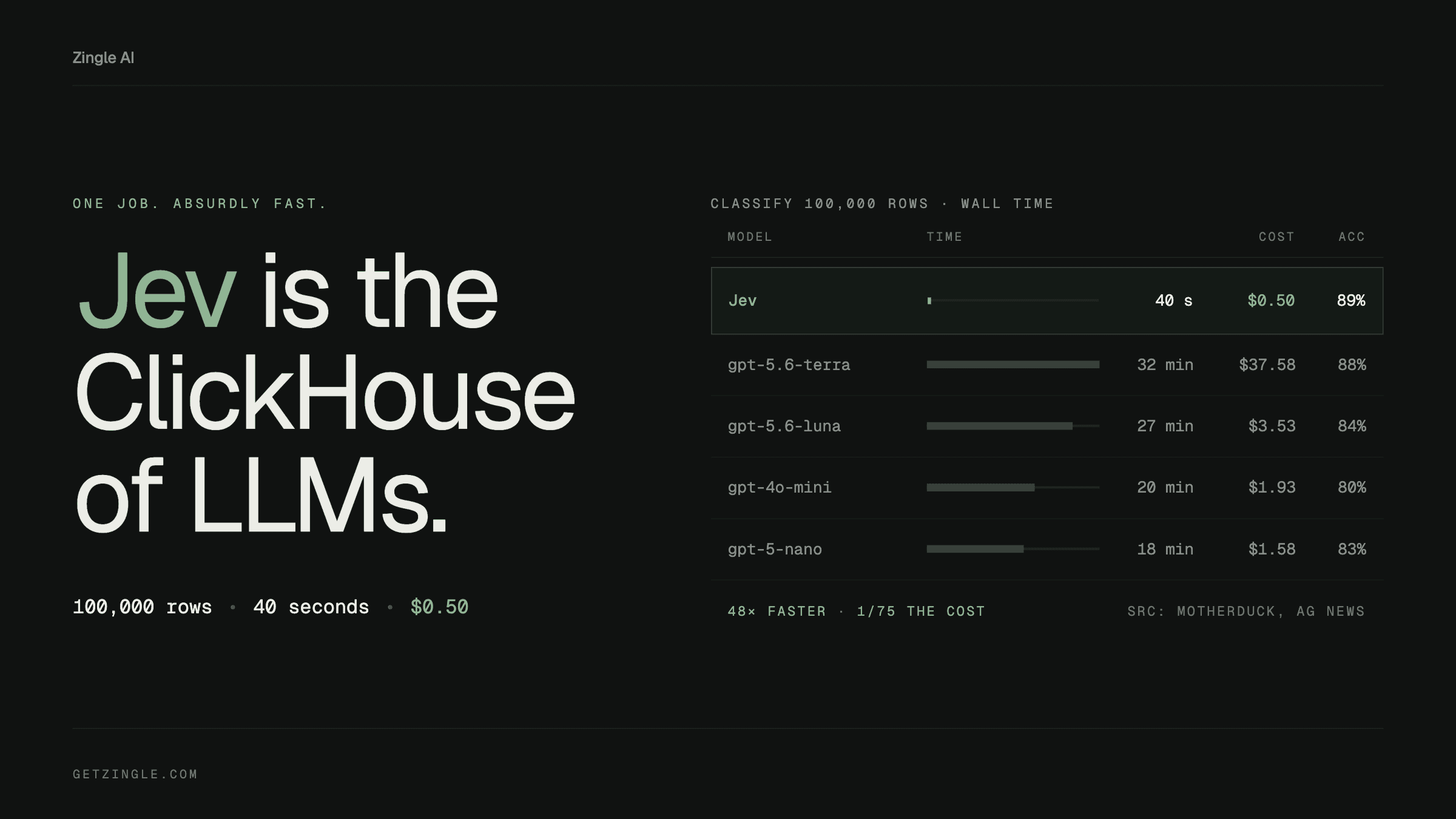
MotherDuck tested Jev on 100,000 news articles. Jev took 40 seconds and cost $0.50. The most accurate GPT model in the same test took 32 minutes, cost $37.58 and scored one point lower: 88% against Jev's 89%.
Until last month, many data teams paid a chat model to answer yes/no questions about rows. To us, that looks like real-time dashboards on Hadoop.
Most of the comparison holds. One part does not, and that part decides who wins inside the warehouse. We return to it near the end.
What ClickHouse taught data teams
Alexey Milovidov started ClickHouse at Yandex in 2009 as an experiment (ClickHouse). His question: can a system build analytics reports in real time from raw events, with no pre-aggregation? The proof took three years. Yandex.Metrica used it in production from 2012. Yandex released it as open source in 2016.
The design was narrow on purpose: columnar storage and fast scans for big aggregations. It was bad at many normal database tasks. Joins were slow for most of its life, and the big join fixes arrived only in 2024 (Tinybird). Updates and deletes were expensive.
Teams used it anyway, because no other tool matched its speed or price for that one job. They flattened their tables, did joins earlier in the pipeline and kept ClickHouse for scans. In 2025, investors valued the company at about $6.35 billion (Wikipedia).
Data engineers already know the rule. When a tool is 50x cheaper at your most common job, you change your design to fit its gaps.
What Jev does
Jev answers questions about a row, and that is the full product. TypeSafe calls it a "System One" model, after Daniel Kahneman's term for fast, intuitive thought.
Jev accepts three types of question:
| Type | What it answers | Example |
|---|---|---|
| Choice | Pick one option from a list | Is this ticket billing, bug or spam? |
| Score | Rate on an ordered scale | How urgent is this, 1 to 5? |
| Noul | Yes or no, as a probability | Does this refund follow policy? |
With the DuckDB community extension, a query looks like this:
SELECT ticket_id,
       jev_choice(tickets, 'which team?', ['billing', 'technical', 'sales']) AS team,
       jev_prob(tickets, 'the customer is angry')                        AS p_angry
FROM tickets
WHERE jev(tickets, 'the customer wants a refund');
Each answer comes back as a normal column that you can filter, join on and test. There are no paragraphs to parse and no broken JSON to repair.
This is the full MotherDuck benchmark. It sorted 100,000 AG News articles into four topics:
| Model | Rows per second | Accuracy | Cost per 100k rows | Wall time |
|---|---|---|---|---|
| Jev | 2,484 | 89% | $0.50 | 40 s |
| gpt-5.6-terra | 52 | 88% | $37.58 | 32 min |
| gpt-5.6-luna | 61 | 84% | $3.53 | 27 min |
| gpt-5-nano | 94 | 83% | $1.58 | 18 min |
| gpt-4o-mini | 84 | 80% | $1.93 | 20 min |
Read the accuracy column first. Jev and the best GPT model are one point apart. The real difference is speed and cost: about 50x faster, at about 1% of the price. ClickHouse made the same trade.
The comparison, side by side
Four rows match closely. The last two rows do not match, and we think they matter most.
| ClickHouse | Jev | |
|---|---|---|
| The one job | Analytical queries on large tables | Typed answers about rows |
| What it gave up | Fast joins, cheap updates and deletes | Text, chat, math, counts, dates |
| The waste it exposed | Real-time dashboards on batch systems such as Hadoop | Chat models that answer yes/no questions |
| How teams use it well | Flat tables, joins done earlier, wide scans | Narrow questions, math in SQL, routes based on confidence |
| Time before rivals answered | Years | Weeks |
| Can you run it on your own servers? | Yes. Open source since 2016 | No. Closed, hosted API only |
How to design around the gaps
ClickHouse teams learned to flatten their tables. Jev teams need their own rules, and four of them appear again and again in the first month of reports.
Start with the gaps. TypeSafe's own documentation lists weak counts, weak arithmetic and weak date comparison. Accuracy also drops on long, noisy input (InfoQ). Astronomer saw Jev react too strongly to the word "Chief" in job titles.
1. Keep math, dates, joins and writes in SQL
Astronomer's CTO gives this advice in What Jev will do to data engineering. Your warehouse already does these tasks well. Give Jev only the judgment.
2. Ask narrow questions
Southbridge changed one vague criterion into a precise one. Jev's score on their test questions went from 0 of 13 to 13 of 13. Sigma ran a phishing test. One broad question got 63% right. Five narrow questions got 95% right.
3. Use confidence to route rows
Astronomer compared Jev with Snowflake Cortex on job titles. When Jev was at least 99% sure, the two agreed on about 98% of rows. When Jev was below 50%, they agreed on about 40%. So the confidence number can route each row.
4. Filter first, then cache
A plain-English WHERE clause cannot use an index. Each row it touches costs one model call. Run your cheap, indexed filters first. Then store the answers, so the next run pays only for changed rows. Jevflake and the DuckDB extension already cache answers by row content and model version.
Four weeks of launches
MotherDuck, Databricks and Snowflake each have a decision function or model now, at least in preview. BigQuery does not.
| Date (2026) | Who | What they did |
|---|---|---|
| Sep 15 | TypeSafe | Released Jev. |
| Sep 21 | MotherDuck | Shipped prompt_jev(), a native SQL function, on all paid plans. |
| Sep 23 | No product. A Google Cloud developer advocate showed how to call Jev from BigQuery through a Cloud Run remote function. | |
| Sep 24 | Databricks | Published a notebook to serve an open-weight Jev-class model and call it from SQL. |
| Sep 30 | Databricks | Shipped ai_decide in Beta. |
| Oct 1 | Cloudflare | Released Clef, a family of open-weight decision models on Workers AI. |
| Oct 5 | Snowflake | Published a guide to run the open-weight decider-2b inside the warehouse. |
| Oct 6 | OpenAI | Launched a Decisions API at $0.10 per million input tokens. |
| Oct 6 | Perplexity | Released Pplx-Decider with open weights under Apache 2.0. |
| Oct 7 | Snowflake | Launched Snowflake Decision in Cortex AI Functions, in private preview. |
| Oct 9 | Microsoft | Released Microsoft-Decision-1 at Jev's price, $0.042 per million input tokens. |
| Oct 9 | TypeSafe | Raised $870M at a $7.5B valuation (TechCrunch). |
Forbes counts more than 15 decision models released after Jev. The list includes models from Liquid AI, Together AI and an open-source project linked to AWS. Most of them shipped within three weeks of Jev's launch. ClickHouse had years before serious rivals arrived.
Look closely at the warehouse moves. MotherDuck and Databricks call a hosted decision model. Snowflake launched its own model, and that model runs inside Cortex. Snowflake says its model got the top score of 72 models on the Jev Decision Index. That is Snowflake's own claim, so we give it little weight. But we read a signal in it: the big warehouses do not want to send your rows to a startup's API.
Where the comparison fails
We like this comparison. But three parts of it do not hold.
You cannot run Jev on your own servers
Anyone can download ClickHouse and run it in their own data center. Jev is a closed, hosted API. Each row that you label goes to TypeSafe. For PII or regulated data, most security teams will say no.
Many of the fast followers are open. Perplexity released Pplx-Decider under Apache 2.0. Cloudflare's Clef, Liquid AI's D1 models and Snowflake's decider-2b have open weights. A developer even built Kev, an open-source model that uses Jev's own API. If ClickHouse is the guide, the winner inside the warehouse will run next to the data. That winner may not be Jev.
Vendors supplied most of the numbers
You could test ClickHouse on your own laptop in one afternoon. Most Jev numbers come from companies with something to sell. TypeSafe designed the workflows behind its claims of 194x faster and 445x cheaper. MotherDuck's benchmark promotes a MotherDuck feature.
Independent numbers are smaller. OpenChamber read 12,759 launch-week posts and collected the speedups that users reported. The median was 7x faster and 30x cheaper (InfoQ). That is still a big gain, but it is far from 194x. Our advice: test a decision model on 1,000 of your own rows before you trust any number. That includes every number in this post.
An answer is a probability
A ClickHouse sum is right or wrong. A Jev answer is a probability. Jev cannot return the wrong type, but it can return the wrong answer with 0.97 confidence. Nothing in the column warns you. ClickHouse never gave a wrong total with a confidence score, so teams never needed tests for that. Judgment columns need those tests.
Seven predictions for the next 12 months
The launch numbers will drop. We think the category will stay. Each prediction below has a test, so you can check our work.
- BigQuery gets a decision function. MotherDuck has one, Databricks has one in Beta, and Snowflake has one in private preview. Google is the only big warehouse with no first-party product. Test: BigQuery ships a decide-style SQL function by mid-2027.
- Open weights win inside the warehouse. This is the ClickHouse lesson again: the winner runs where the data lives. Test: the first large enterprise case studies use models inside the warehouse, not a hosted API.
- Price stops being the main reason to buy. Perplexity already charges $0.02 per million input tokens, less than half of Jev's price. When all vendors are cheap, buyers will compare accuracy and ask whether they can trust the confidence scores. Test: TypeSafe sells on independent calibration results instead of price.
- dbt and SQLMesh support judgment columns natively. Community packages already re-ask only the rows that changed, and they test confidence. Test: dbt or SQLMesh ships official support.
- Observability tools add checks for judgment columns. Current checks watch nulls, freshness and schema. A judgment column also needs alerts for answer drift, lower average confidence and a longer review queue. Test: a major data-quality or observability vendor ships these checks.
- The first bad incident is a silent model upgrade. A new model version changes the answers in a column. A dashboard moves, and the team needs a week to find the cause. Test: a public post-mortem names a model-version change as the cause.
- Total AI spend goes up. Jev's name comes from William Stanley Jevons. He saw that cheaper coal made people burn more coal. Teams will label full tables instead of samples. Test: teams with decision models report higher total AI spend in the warehouse and many more labeled rows per dollar.
The hard part now
ClickHouse found a place next to the warehouse. It took one job that the warehouse did slowly and expensively. Decision models are moving into the same place, and judgment is their job.
A decision model now takes one line of SQL to call. The column it writes to needs much more care. Pin the model version, write tests, give the column an owner and watch it for drift, as you do for any column you care about.
Sources
- TypeSafe AI, Introducing System One Models & Jev
- ClickHouse, Introducing ClickHouse, Inc.
- Wikipedia, ClickHouse
- Tinybird, ClickHouse JOINs improvements
- MotherDuck, prompt_jev(): Text Classification in SQL
- Julian LaNeve and Kaxil Naik, Astronomer, What Jev will do to data engineering
- Hrishi Olickel, Southbridge, Using system-one models inside high-throughput data pipelines
- Sigma, What is Jev? How to use it in Sigma through MotherDuck
- Databricks, Introducing ai_decide and Running open-Jev in SQL on Databricks
- Snowflake, Snowflake Decision in Cortex AI Functions and Decisions Are All You Need
- Jeff Nelson, Google Cloud Community, Bring Jev to BigQuery with Cloud Run
- Fortune, Jev has been a viral hit, but OpenAI is hot on its heels
- Ron Schmelzer, Forbes, A Guide to the New Wave of AI Decision Models Besides Jev
- TechCrunch, The maker of Jev valued at $7.5B weeks after launch
- Daniel Curtis, InfoQ, TypeSafe AI Releases Jev
- GitHub, Jevflake; DuckDB, jev community extension